What does a 1-1 behavioural consultation involve?
 Jules Ballard
I explain what makes me different and what a 1-1 consultation involves, using a real life case study to illustrate my behavioural support plan.
When guardians consult for a behavioural issue they have usually tried many strategies already and are often quite stressed, anxious and frustrated themselves. Their dog has usually been practicing the behaviour for some time and in many cases, years. They may have tried several other trainers or behaviourists previously. Often one of the first questions I am asked is:
‘What makes you different’?
I treat every dog and human individually, using my knowledge of psychology to tailor a programme that is specific to your learning style, your needs and those of your dog, but the major difference is that I use traditional behavioural support plans alongside botanicals and energy methods. I ask you to see your vet, (if you haven’t done so recently) to rule out any physical reason for your dog’s behaviour and to inform them that we are working together, and agree to Terms and Conditions to that effect. I take a detailed history of your dog, which includes diagnosed conditions, symptoms, any medications, any behavioural concerns, their character, diet and lifestyle. This helps me to decide on their root element, their out of balance element and their root organ. Being aware of your Chinese element and subtypes impacts on the types of treatment chosen. All essential oils are also aligned to elements, for example Rosemary is Fire, Water and Earth and Juniper Berry is Metal and Water. Five Element Theory can help to choose essential oils, but not all the oils chosen have to ‘belong’ to a particular element. If you are drawn to a particular oil or your animal self-selects a particular oil this will be because their body senses they need it. Knowing which element rules which function is one of the keys to grasping the Five Element Theory and being able to use it to choose essential oils, herbs and other healing modalities for yourself and your animal. But it is important to remember that in Chinese medicine, nothing is fixed, all energy is fluid, dynamic and circular, so you do not have to fit rigidly into a particular box.
I apply the 8 TCM principles to help identify their pattern. I compile a list of symptoms and decide where these fit in relation to the principles, vital substances and organ. I also ask for photos and video of the animals, as how they look, stand, sit and move helps to formulate their plan. I also need to know about you, any stress, worries, conditions or medications you are on. Sometimes a dog will self-select essential oils not because they need them, but because their guardian does. One of the first dogs I ever worked with, a 7-year-old collie mix, I was consulted for apparent overwhelming anxiety in the dog. The guardian sent a video of what appeared to be a very calm dog and I wondered if the dog was in fact shut down and not calm, but when I met them both, the dog was genuinely calm, but the guardian was the one with overwhelming anxiety, it took ages for her to be able to sit still long enough to offer the oils, but once she did, the change in her was remarkable, I watched her shoulders relax and her dog selected all the oils that helped her, as well as ones for her own anal glands (the dog not the human)!, it was beautiful to see.
So, once I have finished data gathering I devise a short list of plant extracts that you can offer your dog. This is usually about 5-7 essential oils and /or hydrosols and includes a Chinese herbal formula and acupressure points to try. Botanicals are always offered by self-selection and never added to food or water, so that your dog can innately select what they need. I will use Millie, a Spitz/Husky cross who was 15 months old at the time of assessment and recently adopted as a case study, to explain how I reached a treatment plan
Millie is slender, but muscular. Her fur is in good condition, sleek, soft and no dryness, her eyes are bright and clear, she looks wary on occasion (with narrow slanted eyes, dropped head and tail, but is starting to relax more with her guardians, she is paler around her mouth and on her paws.
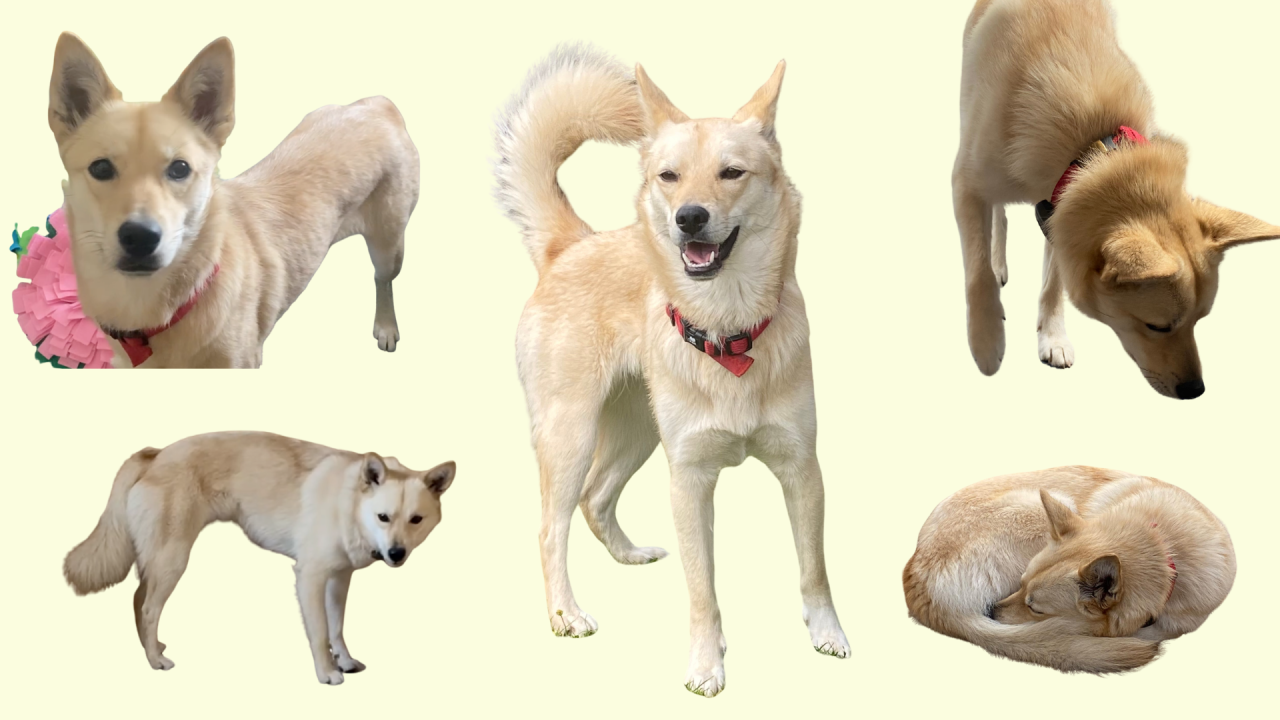
Her root element is Water shown by how she will run away or fight as a default, doesn’t trust easily, is strong willed, self-sufficient, determined, cautious, reserved, withdrawn, bites when fearful or unsure, watchful from a distance, escapes, hides under tables or worktops, and had a difficult beginning to her life as relinquished to a shelter, and neutered early.
Her out of balance element is Fire shown by how she is overdramatic and noisy (repetitive barking at multiple stimuli), wants her space respected, is vulnerable, highly strung, easily bored, dislikes confinement and isolation, shy, timid, lacks confidence, can be quite agitated, seeks connection, but then backs off, wants to be centre of attention, and gargles when greeting.
Devising the behavioural support plan
The main issues the guardians wanted help with were her excessive barking, timidity, anxiety, tension and fear aggression. From all the information obtained I formulated a list of symptoms. This is an excerpt from the list, but not its entirety.
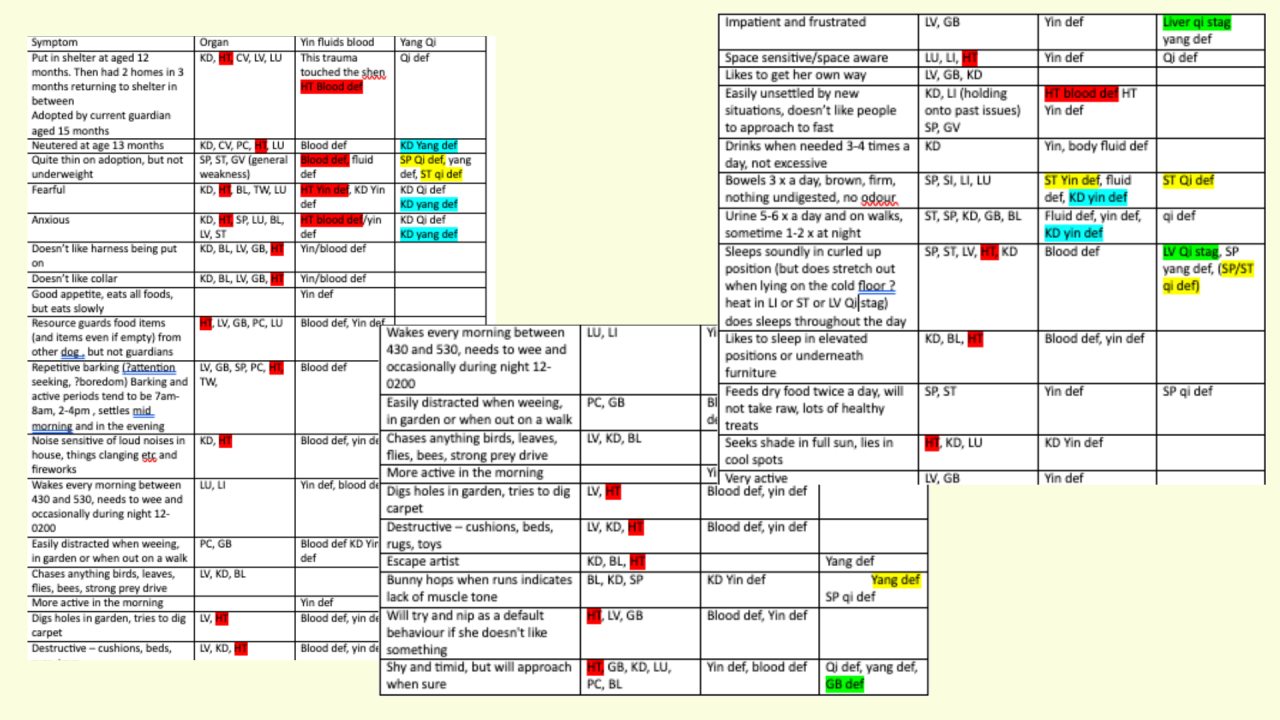
I then link these to all the organs applicable, yin, yang and 4 vital substances of Blood, Fluids, Qi and Essence. As you can see from the amount of highlighted red that Heart is the organ that is clearly standing out, which leads to the conclusion that Heart is her root organ.
Using the 8 principles she identified as Yin, deficient, hot, and internal. A yin deficient animal has less fluids and more fire, so is hot. Millie will seek a cool floor to lie on or the shade and is always on the go. In contrast a yang deficient animal has more fluids and less fire so will appear cold and lacking in energy.
From this information together with a meridian balance assessment (MBA) I can then decide on what essential oils, herbs or acupoints I wish to use. Millie’s MBA showed an imbalance in several meridians; Conception Vessel, Governing Vessel, Heart, Small Intestine, Bladder (Left side only), Heart Protector and Gall Bladder with the Heart being the priority, further backing up Heart being the root organ. These imbalances reflect her current behaviour and symptoms.
It is also important to note that as our animals are so good at picking up on our energies, sometimes their MBA can reflect what we are feeling.
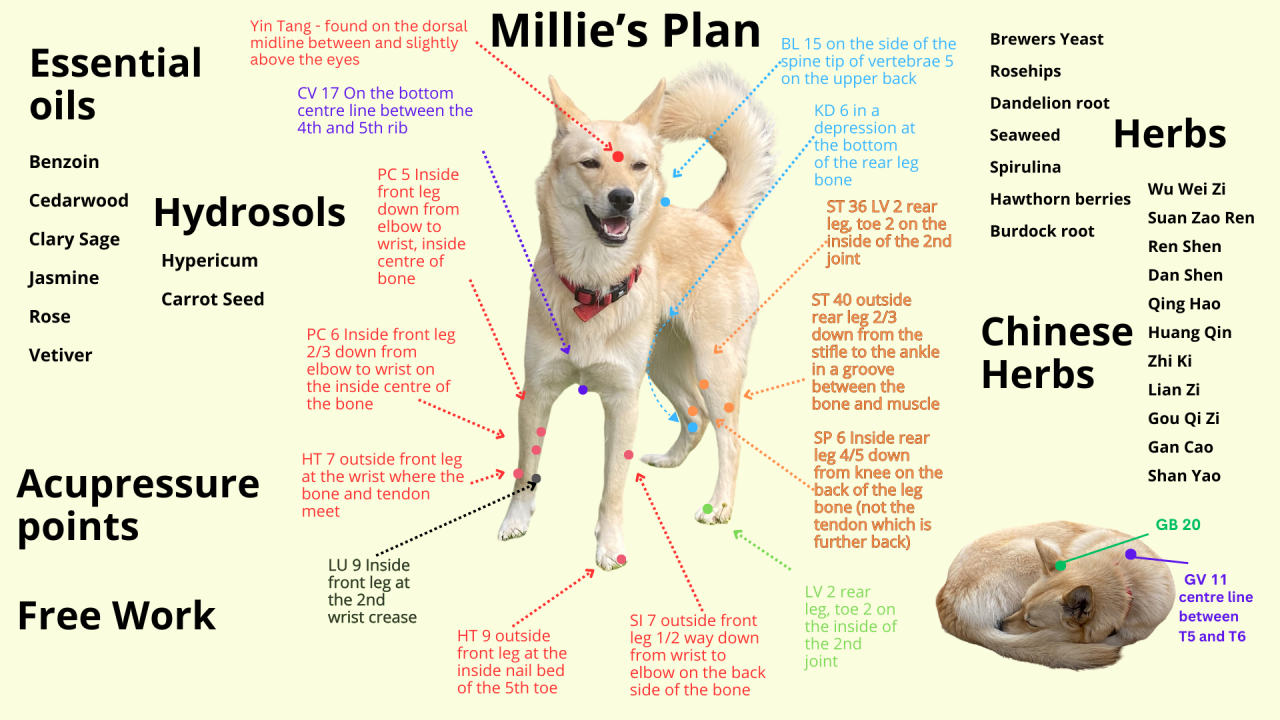
Though essential oils and hydrosols are not traditionally part of TCM, when I work with an animal, I like to use them as they are great for emotional issues and compliment acupressure and herbs.
This whole plan was followed 4-5 times a week for 4 months and still continues today with herbs and oils being offered 1-2 times a week. Millie was touch sensitive and did not tolerate any acupoints on her limbs, but did like the head, chest and back points. Like all therapies they are offered on a self-selection basis. And of course, Free Work was part of the plan. It has been wonderful to see a traumatised, fear-aggressive dog learn to feel safe and adapt to her new home.
This case study emphasises the importance of having a patient, consistent approach that went at her pace and being prepared to frequently reassess and adapt the plan to suit Millie.
What plan would suit you and your dog?
If your dog has a condition, pain or simple behavioural issue such as age-related fears or noise sensitivity, most guardians choose a package of either 4 or 8 sessions where we work together. I often utilise other strategies such as ACE Free Work, Emotional Freedom Technique for humans and animals, and support and relaxation techniques for you in separate sessions
Some guardians may choose a 1-1 consultation, then work alone or alternatively purchase a self-paced course and starter kit of either oils, herbs or crystals. I have many courses available that I offer my wellness clients to enable them to benefit from this wonderful modality. Check out my courses if this is something that interests you.
As self-selection is a balancing treatment, the changes observed can be subtle. You can see rapid improvements and, in some cases, very little improvement. Following a behavioural support plan and offering plant extracts takes commitment, time and patience. Initially, for dogs the offerings will be once or twice a day depending on their choices and many guardians, even with the best will in the world simply do not have the time to sustain an in depth programme. They may be better suited to a stand-alone course, that they can work through when they have time.
However, my experience has shown that it is incredibly challenging living with a dog with anxiety or other behavioural issues and guardians appreciate the support and listening ear that a package provides. It is for this reason that I offer a completely holistic approach of working with both the human and the animal.
If you would like to work with me on a 1-1 basis or purchase one of my starter kits, then please check out my services section.
Animals are amazing in their ability to know just what they need, and I learn from them every day.
Jules Ballard - Author of Holistic Help For Your Anxious Dog https://www.amazon.co.uk/Holistic-Help-Your-Anxious-Dog/dp/B0H6BX4M7N/
Holistic Haven Circle Membership - Wellness for people and Paws - A community for ongoing holistic support, learning and connection https://holistichaven.newzenle...
Categories: : Behaviour, Botanical Spotlight